
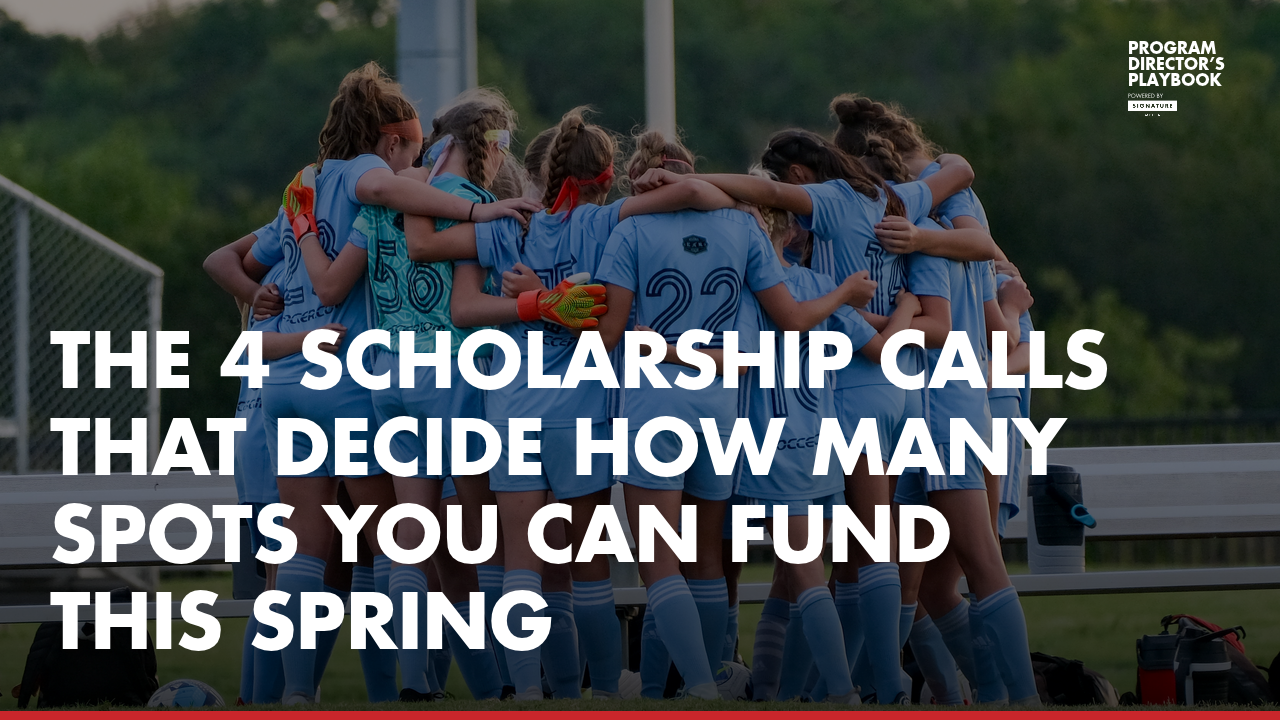
Some families in your program are already doing the math on spring. They're weighing the season fee against holiday spending and the cleats their kid outgrew in October, and most of them will find a way. A few are quietly deciding whether they can, and they'd sign up sooner if they knew help was there.
You already say yes to families in that spot. Most directors have found room for a kid after a parent asked, with no form, no policy, and no budget line behind the decision. That instinct is generous and it works, and it has one built-in limit: it only reaches the families willing to ask, and they tend to ask in January, when spring teams are filling and the spot has to be found in a week.
Families are budgeting for spring right now. The Aspen Institute's Project Play parent survey put the average family's spending on a child's primary sport at $1,016 in 2024, up 46% from 2019, and a family weighs a number like that against holiday spending well before registration opens. A family that doesn't know help exists will often decide on its own that spring isn't possible, and you find out when the roster has a hole in it.
Giving Tuesday, on December 1, gives you the other half of the answer. "Financial aid" is a category, while "one spot for one kid" is something a donor can picture, a family can be told about, and you can report back on. A gift lands best when the spot exists before the gift does.
Call it the standing offer: a number, a rule, a door, and a date, written down before any family asks and before any donor gives. It formalizes what you already do case by case, and it turns a private favor into something a family can count on and a donor can fund. Four calls build it, and each one fits on a single line of a one-page plan.
Decide how many spots the program funds, and set that number before you look at a single donation. A workable starting rule is one funded spot per team, adjusted after the first season once you see how many families use them. Price it in plain dollars: if a season costs a family $350 and you run six teams, six spots come to $2,100, and "$350 funds one spot" is the sentence a donor will see.
Fund the first spots from the program's own budget so the offer is real on the day you announce it. Gifts then add spots on top of that floor, which means a slow December never takes the offer away from a family that was already told yes.
Write down who qualifies in terms a parent can read in ten seconds. The simplest rule asks a family to say they need help and takes their word for it, which keeps paperwork out of a conversation that is already hard. If you want a second rule, make it a limit on the spots rather than a test for the families: requests are honored in the order they arrive until the spots run out.
Decide whether a spot is full or partial. A half-price spot stretches the same gift across twice as many kids, and some families would rather pay half than ask for all of it, so offer both and let the family choose.
Choose how a family asks, and make it one door that nobody else watches. A single email address that goes straight to you works, as does a checkbox on the registration page that reads "I'd like to talk about financial help." Coaches never see the requests, team managers never see them, and no request travels through a group chat.
Then put the same sentence in every spring email rather than in a special one: "Financial help is available for every team this spring. Reply to this email or check the box at checkout, and only the director will see your request." A line that appears in every message tells a family the offer is routine, which is exactly what a family weighing spring needs to hear.
Commit to a response time and a deadline. Answer every request within three business days, since a family that waits a week reads the delay as a no. Then set the date that decides what gifts do: a gift received by December 15 funds a kid's winter session if you run one, or holds a spot for spring if you don't, and anything that arrives later rolls into the next open spot.
A funded spot should look like every other spot on the roster, in every list, email, and team page. The family has asked privately and been answered privately, and nobody else on the team ever learns which registrations came through the standing offer. Coaches see a kid on the roster, and the kid sees a team, which is the entire point of the offer.
The recognition goes into your report to donors. A donor wants to know what their gift did, and "your $350 funded one spot this winter" tells them everything they need without a name, a story, or a photo of a kid who never agreed to be the story. A short note in January listing how many spots were funded and how many kids are playing gives your donors a reason to give again next December.
Once the plan exists, Giving Tuesday is a single message with a number in it. Send it to families, alumni, and the local businesses that already know your program: "$350 funds one spot for one kid in our program this season." Post the same sentence on your website and your social pages, and link it to wherever your program accepts gifts. If you aren't sure of the cleanest way to take them, a short conversation with your accountant before December 1 will answer it.
Your staff should hear the parent logic once, in plain words. A family that asks for help is making a sensible decision about a budget, and the program that makes it easy is protecting the family's dignity and the roster at the same time. The family wants their kid on the team and you want the same kid on the team, so a standing offer gives both of you the same answer.
Write the one-page plan by Friday, November 20, before Thanksgiving week fills your calendar: the number, the rule, the door, and the date. Add the sentence to your next spring email, and spend five minutes with your coaches telling them one thing, which is to send any family who asks about cost to the director's address and say nothing more.
By December 1 there is somewhere for every gift to land, and every family doing the math on spring has its answer before it has to ask.
One practical system for growing, staffing, and running your program. Free, and written for directors who are short on time.
Exclusive savings for your program from Back 2 Sports Hub partners.